engage audiences + ignite change + build brands
Disrupting Cybersecurity through Visual Duality
The Challenge
The cybersecurity landscape is notoriously saturated with a "sea of sameness"—generic blue gradients and abstract shield icons that fail to resonate with a cynical, highly technical CISO audience. For a hyper-growth company like Abnormal AI, the primary hurdle was moving beyond traditional brand sentiment to drive direct pipeline growth and market penetration. The brand creative and marketing teams faced the dual pressure of scaling a visual identity system while humanizing complex AI-native security concepts for an audience that prioritizes technical substance over typical marketing fluff.
The Strategy
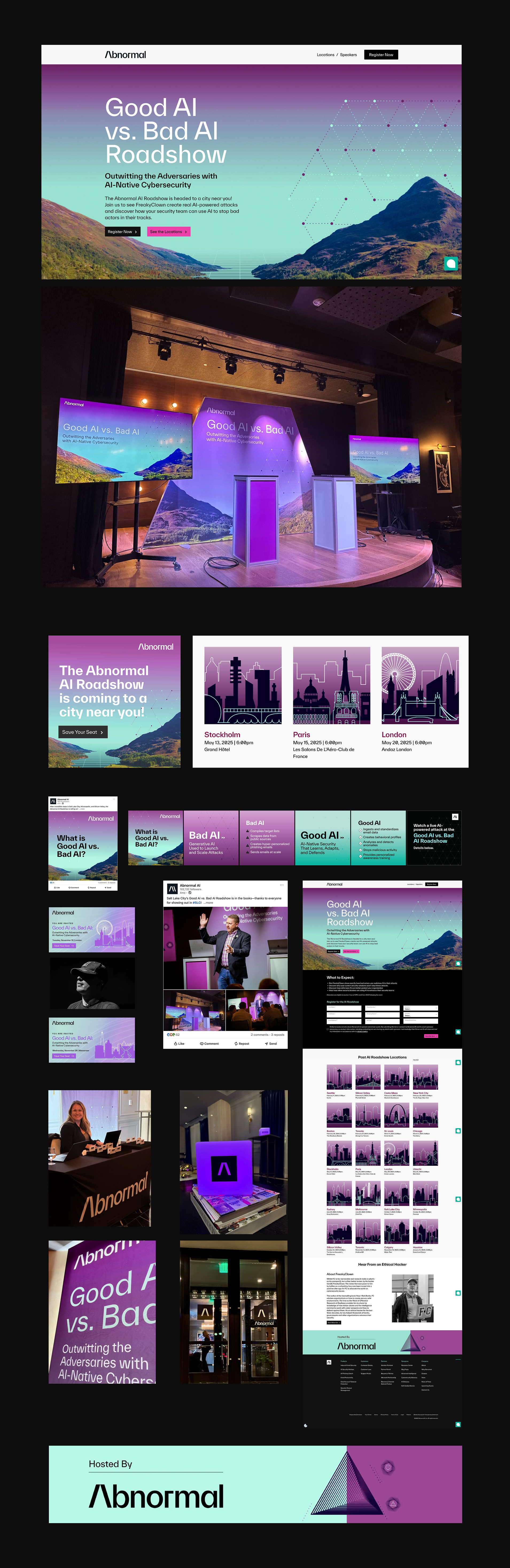
To break through this aesthetic stagnation, the brand strategy centered on a striking visual duality that merged the "real world" with the digital frontier. The creative team juxtaposed organic imagery, such as expansive landscapes, with the rigid structures of the digital world—isometric grids and intricate digital nodes. This metaphor was amplified through a high-contrast color palette that replaced the industry’s standard "safe" blues with a vibrant conflict: Mint Green representing "Good AI" and Bright Magenta representing "Bad AI." This bold chromatic hierarchy was applied across all "Good vs. Bad AI" Roadshow touchpoints, creating a distinct, high-fidelity brand language that visualized the invisible battle of behavioral AI in a way that was both artistically disruptive and technically resonant.
Results
The execution of this strategy served as a massive growth engine, directly contributing to Abnormal AI’s 100% YoY growth to $200M ARR and a valuation of $5.1 billion. By scaling the creative team from one to nine employees and executing two holistic rebrands alongside four visual identity transformations, the marketing team demonstrated that high-fidelity brand creative is a mechanical necessity for pipeline enablement. The industry validated these efforts with "Best Security Company" honors at the SC Awards and a spot on Fast Company’s "Most Innovative Companies" list, proving that a bold, artistically driven brand identity can effectively bridge the gap between high-level artistry and hard-core business metrics.